
/prod01/channel_8/media/scu-dep/current-students/images/Coffs-harbour_student-group_20220616_33-147kb.jpg)
/prod01/channel_8/media/scu-dep/current-students/services/counselling/images/RS21533_English-College-Student_20191210_DSC_6961-117kb.jpg)
/prod01/channel_8/media/scu-dep/study/scholarships/images/STEPHANIE-PORTO-108-2-169kb.jpg)
/prod01/channel_8/media/scu-dep/study/arts-and-humanities/images/RS20958_Chin-Yung-Pang-Andy_20190309__79I5562-960X540.jpg)
/prod01/channel_8/media/scu-dep/experience/images/SCU-INTNL-STUDY-GUIDE-280422-256-72kb.jpg)
/prod01/channel_8/media/dep-site-assets/component-library/screenshots/online-1X1.jpg)
/prod01/channel_8/media/scu-dep/news/images/2026/Divers-sampling-corals-at-Lady-Musgrave-Island-on-GBR_DJI_0392_RiversideMarine-2000X973.jpg)
Share
The offspring of a common coral branching species set up new homes up to 100 kilometres or more from their parents in one of the longest dispersal distances ever measured, according to new international research out of Southern Cross University.
Led by Southern Cross University and the French National Centre for Scientific Research and published in the journal Current Biology, the paper shows, for the first time, the connectivity between the broadcast-spawning coral populations of the Great Barrier Reef, Coral Sea atolls and New Caledonia in the Western Pacific.
Main photo: Divers sampling corals at Lady Musgrave Island on the Great Barrier Reef, Australia (credit: Riverside Marine).
Quick facts
Long distance coral gene flow across the Western Pacific
Offspring of a common coral branching species set up a new home up to 100km or more from their parents in one of the longest dispersal distances ever measured.
Findings show the connectivity between the broadcast-spawning coral populations of the Great Barrier Reef, Coral Sea atolls and New Caledonia in the Western Pacific.
Wide dispersal can help populations recover after disturbances while exchange of gametes and genetic variants over vast distances can help other populations to adapt to their own changing environmental conditions.
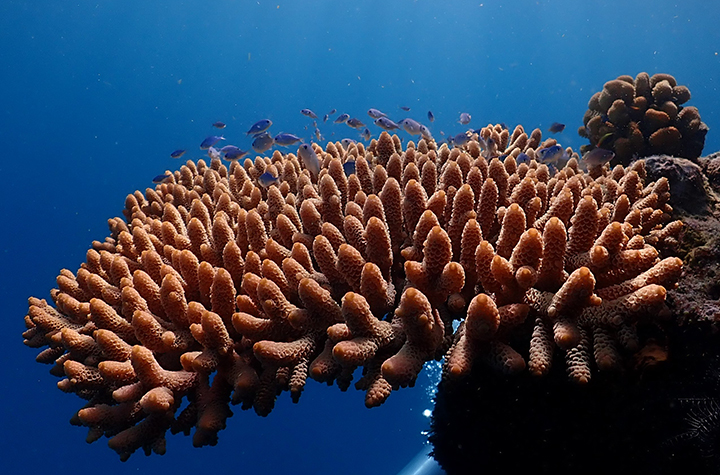
A colony of the studied species, Acropora cf. spathulata, at Fitzroy Reef on the Great Barrier Reef (credit: M Grinblat).
The Australian and French researchers sampled more than 1,000 corals and 29 reef sites to discover the branching coral Acropora spathulata forms large, interconnected breeding populations. Its spawn hitches a ride on ocean currents to disperse widely.
The findings underscore the importance of considering diversity and connectivity in management interventions, and the need for conservation networks that extend beyond national borders.
“Genetic diversity is the fuel for adaptation; like a shared toolbox in a community: the greater the variety of tools, the better it can build new things, fix problems and respond to changing conditions.”
/prod01/channel_8/media/scu-dep/news/images/2026/Hugo-Denis_2026-May-19_P1644164-2_MBoussion-low-res.jpg)
Lead researcher and first author Dr Hugo Denis of Southern Cross University and Sorbonne Université completed the study for his PhD research.
“On average, coral parents and their offspring are separated by about 100 kilometres. This wide dispersal can help populations recover after disturbances such as marine heatwaves, crown-of-thorns starfish outbreaks or cyclones," said Dr Denis.
“This also allows populations from Australia and New Caledonia – separated by thousands of kilometres – to occasionally exchange gametes and genetic variants, distinct ‘tools’ shaped over thousands of years that can help other populations to adapt to their own changing environmental conditions.”
In reef-building corals, the diversity of the genetic toolbox comes from both the coral animal and the photosynthetic algal symbionts living in its tissues.
The research team found that Acropora spathulata hosts five distinct algal taxa depending on environmental conditions, which may provide additional pathways to adaptation.
“As marine heatwaves become more common, coral reefs can only survive if coral populations can adapt to cope with warmer waters and can recover after parts of the reef die,” said Dr Denis.
“Genetic diversity is the fuel for adaptation; like a shared toolbox in a community: the greater the variety of tools, the better it can build new things, fix problems and respond to changing conditions.”
The secret journey of baby corals
Connectivity – the movement of individuals or gametes through the open ocean –determines how quickly reefs can be repopulated after die-off events, and how much populations can share and exchange their genetic ‘tools’ (variants) for adaptation.
Yet the extent of genetic diversity within reefs and connectivity among reefs is unknown for most coral populations.
Senior co-author on the paper Professor Cynthia Riginos, from the Australian Institute of Marine Science (AIMS) and the University of Queensland, said uncovering long distance connections among reefs is only possible when studies are able to sample distant populations such as those from New Caledonia, the Coral Sea and the Great Barrier Reef.
“This is what makes Hugo’s study unusual and important. Sampling across this geographical extent is rare,” she said.
"This work also adds to our understanding of how microalgal symbionts are distributed across coral colonies on the reef. It is much more about the environmental conditions the symbionts find themselves in than it is for the coral host species."
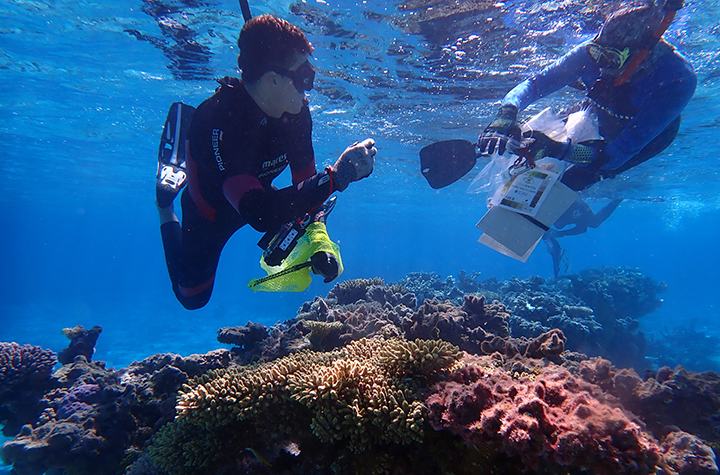
Hugo Denis (left) and colleague Bertrand Bourgeois collecting coral samples in a reef from the Bellona Plateau located in the Coral Sea (credit: Magali Boussion).
A French scientist in the Pacific
Hugo Denis originally came to Australia from France to work as a Research Assistant in the Reef Restoration and Adaptation Program (RRAP) with Dr Emily Howells of Southern Cross University and Dr Line Bay of AIMS (Australian Institute of Marine Science). His intention was to continue as a PhD candidate investigating the genetic basis of coral heat adaptation.
"We then had the opportunity to expand the PhD project to a broader geographic region encompassing atolls in the Coral Sea and New Caledonia, through a collaboration with scientists at the Institute for Research and Development (IRD) in Nouméa, where I had previously completed an internship," explained Dr Denis who is based in New Caledonia.
He said the postgraduate research experience through Southern Cross University has been life changing.
"Studying at Southern Cross University and being part of RRAP research team, one of the leading groups in coral genetics, was an amazing opportunity for me. The international collaboration we established further enhanced my interest in the project as it allowed us to investigate how patterns of genetic diversity and connectivity underpin resilience and adaptive potential across the southwestern Pacific region. We also examined whether geographically distant coral populations have adapted to heat stress via shared or distinct genetic mechanisms, with important implications for the transferability of conservation and restoration strategies based on genomic predictions of coral adaptive potential.
"One of the most exciting aspects of this PhD journey was the opportunity to engage with a wide variety of environments, nationalities, and institutions in Australia and New Caledonia, gaining new insights from scientists, practitioners, and local communities."
Study details
‘Contrasting population structures of reef-building corals and their algal symbionts inform adaptive potential across the Western Pacific’ by Hugo Denis, Katharine E Prata, Hisatake Ishida, Iva Popovic, Véronique JL Mocellin, Magali Boussion, Ilha Byrne, Steven W Purcell, Line K Bay, Gaël Lecellier, Cheong Xin Chan, Cynthia Riginos, Emily J Howells, Véronique Berteaux-Lecellier.
Journal: Current Biology
Acknowledgements
This research was conducted as part of a collaborative PhD project between Southern Cross University (Australia) and Sorbonne Université (France), and was supported by the Reef Restoration and Adaptation Program, the Australian Institute of Marine Science, the University of Queensland, the Embassy of France in Australia Pacific Fund, the Resilient Reefs Initiative, the French National Centre for Scientific Research (CNRS), and the French National Research Institute for Sustainable Development (IRD). The Reef Restoration and Adaptation Program is funded by the partnership between the Australian Government’s Reef Trust and the Great Barrier Reef Foundation.
Coral sampling was conducted with permission from the Great Barrier Reef Marine Park Authority as well as the South Province, North Province, and Government of New Caledonia.
Media contact
Sharlene King, Media Office at Southern Cross University +61 429 661 349 or scumedia@scu.edu.au
Keep reading
All Media ReleasesStudents take their learning global in Indonesia
/291x0:910x619/prod01/channel_8/media/scu-dep/news/images/2026/Indonesian-trip---SCU-News-Web-Banner--2000-X-1032-px.png)
From climate resilience to AI innovation, researchers RISE to the challenge
/484x0:1516x1032/prod01/channel_8/media/scu-dep/news/images/2026/RISE.jpg)
/484x0:1516x1032/prod01/channel_8/media/scu-dep/news/images/2026/L-to-R-Professor-Dirk-Erler-Dr-Nedeljka-Rosic-and-Dr-Shane-McIntosh--2000px-x-1032px.png)
/514x0:1487x973/prod01/channel_8/media/scu-dep/news/images/2026/Obesity_credit-Towfiqu-Barbhuiya-on-Unsplash-2000X973.jpg)
/514x0:1487x973/prod01/channel_8/media/scu-dep/news/images/2026/Newborn-foot-credit-Anugrah-Ajay-Lohiya-on-Pexels-669151-2000X973.jpg)
Research excellence takes the stage at Lismore graduation
/484x0:1516x1032/prod01/channel_8/media/scu-dep/news/images/SCU-News-Web-Banner--2000-X-1032-px.jpg)
/514x0:1487x973/prod01/channel_8/media/scu-dep/news/images/2026/Woman-with-Quit-written-on-her-hand-credit-RDNE-on-Pexels-6003530-2000X973.jpg)
/484x0:1516x1032/prod01/channel_8/media/scu-dep/news/images/2026/AI.jpg)
Regional Leaders Academy grows Northern Rivers talent pipeline
/484x0:1516x1032/prod01/channel_8/media/scu-dep/news/images/2026/RLA.jpg)
/484x0:1516x1032/prod01/channel_8/media/scu-dep/news/images/2026/Inna.jpg)