
/prod01/channel_8/media/scu-dep/current-students/images/Coffs-harbour_student-group_20220616_33-147kb.jpg)
/prod01/channel_8/media/scu-dep/current-students/services/counselling/images/RS21533_English-College-Student_20191210_DSC_6961-117kb.jpg)
/prod01/channel_8/media/scu-dep/study/scholarships/images/STEPHANIE-PORTO-108-2-169kb.jpg)
/prod01/channel_8/media/scu-dep/study/arts-and-humanities/images/RS20958_Chin-Yung-Pang-Andy_20190309__79I5562-960X540.jpg)
/prod01/channel_8/media/scu-dep/experience/images/SCU-INTNL-STUDY-GUIDE-280422-256-72kb.jpg)
/prod01/channel_8/media/dep-site-assets/component-library/screenshots/online-1X1.jpg)
/prod01/channel_8/media/scu-dep/news/images/2025/Bruce-Thom-w-Chris-Klaas-and-Muhammad-Islami_2025-Nov-credit-East-Coast-Conferences---Copy.jpg)
For most Australians, the coastal zone is our playground. Yet this landscape of beaches and coastal waters, rocky and sandy shorelines, dunes, estuaries and coastal lakes is under increasing pressure from growing population and urban settlements, industrial and commercial activity, tourism and recreation.
Deep dives into understanding the lives of leaf oysters and macroinvertebrates – regarded as unsung and little-known heroes of Australia’s estuary systems – have rewarded two Southern Cross University postgraduates.
PhD candidates Chris Klaas and Muhammad Islami are joint winners of the Emeritus Professor Bruce Thom AM Student Research Award which recognises academic study that promises to positively contribute to coastal management.
Professor Bruce Thom, the founding father of the Australian Coastal Society and for whom the award is named, was on hand to congratulate the Southern Cross University duo at the 2025 NSW Coastal Management Awards in November at Ballina.
MAIN IMAGE: Professor Bruce Thom (left) with Chris Klaas and Muhammad Islami (credit East Coast Conferences).
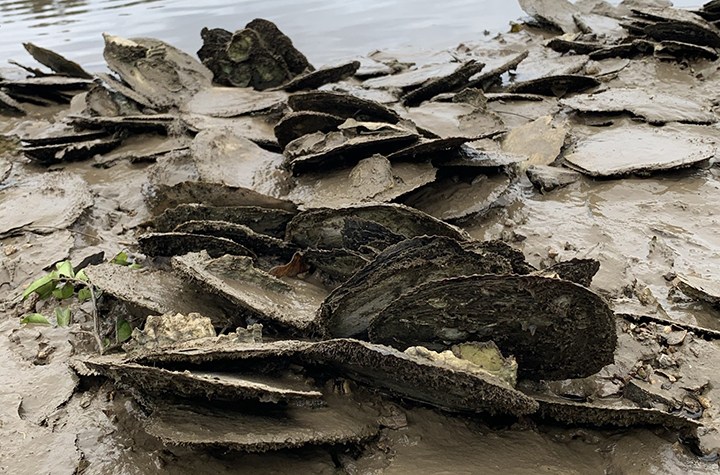
Leaf oysters at Woolgoolga (credit Kirsten Benkendorff).
Professor Thom commended Chris for his pioneering journey of discovery with the native leaf oyster (Isognomon ephippium).
“Particularly in the field of its sex life, Chris is working his way through the whole reproductive system and learning about how things are cultured because we know so little about the leaf oyster,” said Professor Thom.
“The work started from his Honours project and it's developing into very sophisticated PhD project. Chris is looking at optimal sites which could have conservation interests or restoration interests. It's going to be a lifetime’s work, Chris.”
Professor Thom was also full of praise for Muhammad’s revolutionary research.
“Muhammad has brought to ecological work two incredibly important skills,” said Professor Thom.
“One, which is now rare in many ways, and that's as a parataxonomist. A taxonomist of macroinvertebrates. And to be able to devote your life to the taxonomy of anything, I think is an incredibly important thing. He’s also specialising in environmental DNA work.”
By bringing those two techniques together, Muhammad, Professor Thom told the audience, was investigating the role of macroinvertebrates in estuarine systems to assist in the monitoring of waterway health, particularly in the post-recovery phases after a flood.
“Muhammad is developing more efficient ways of collecting and analysing data that will help us understand better where the recovery rates, in terms of the ecological systems, are occurring faster than others, and where we need to look at more seriously the problems of depletion and damage.”
Professor Thom concluded by saying how thrilled he was to be exposed to new knowledge through his involvement in these awards.
“It really is something I found most exciting and interesting, coming to a conference and looking at these nominations and learning something completely new about the way in which a particular ecological phenomenon is being worked on,” he said.
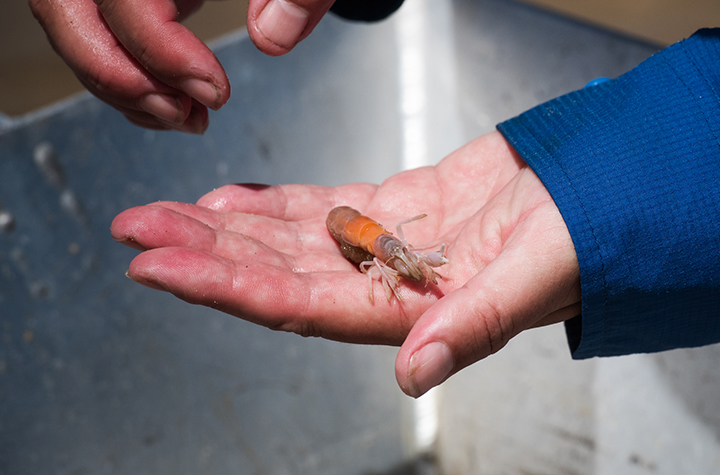
Aquatic macroinvertebrates are a diverse range of creatures including yabbies (shown), snails, worms, crustaceans and more.
“It is incredibly rewarding to see my research on Isognomon ephippium (also known as the leaf oyster) recognised for the potential these oysters hold as ecosystem engineers.”
/prod01/channel_8/media/scu-dep/news/images/2025/Chris-Klaas-with-leaf-oyster_20231005_credit-Chris-Klaas-767-px.jpeg)
Both Chris and Muhammad acknowledged that pursuing a PhD was challenging yet ultimately rewarding.
Chris said: “A PhD journey can feel solitary at times, especially when working deeply within a knowledge gap sometimes only known by small number of people. It is incredibly rewarding to see my research on Isognomon ephippium (also known as the leaf oyster) recognised for the potential these oysters hold as ecosystem engineers.
“Expanding our understanding of new candidate species for oyster reef restoration is essential for extending restoration efforts into new locations and habitats. By studying I. ephippium's recruitment patterns, reproductive cycle, and physiochemical tolerances, we can help secure its place in future multi-species shellfish reef restoration. These oysters have great potential to enhance broader ecological restoration efforts across a wide range of habitats,” said Chris, noting that he is grateful to his supervisors for their guidance and mentorship during the project.
“Having this work recognised feels very encouraging. I'm sure the knowledge and experience I’m gaining here will be valuable for addressing similar environmental challenges back home in Indonesia. ”
/prod01/channel_8/media/scu-dep/news/images/2025/River-Research-Project_Muhammad-Islami_26022025_DSC_8898_credit-Southern-Cross--University-low-res.JPG)
Muhammad, an international student, said: “Winning this award really means a lot to me.
“My PhD looks at how floods and other pressures affect estuarine macrobenthic biodiversity in northern NSW, so having this work recognised feels very encouraging. It reminds me that all the hard work, long days in the field and lab are worthwhile. It also motivates me to keep learning and I'm sure the knowledge and experience I’m gaining here will be valuable for addressing similar environmental challenges back home in Indonesia. Thank you to my supervisors for their guidance, and to everyone who has supported me along the way.”
/prod01/channel_8/media/scu-dep/news/images/2025/River-Research-Project_research-team-in-boat_26022025_DSC_9478_credit-Southern-Cross-University-low-res.JPG)
PROFESSOR KIRSTEN BENKENDORFF: Since 2022, we've been sampling a number of rivers on the North Coast and Mid North Coast of New South Wales and we're sampling the estuaries to look at the macrobenthic communities, to see how they've recovered after the floods.
So some of the processes that we're using in the project involve taking these core samples of the sediment which we can then sieve and pull out all of the little macroinvertebrates and those invertebrates are then sorted under the microscope and we use those to identify and get some idea of the diversity of things that live in the sand but in addition to that we're also taking some of these sediment samples that we can test for their nutrient levels and the heavy metals and thus we can see if there's contamination and how that relates to those invertebrate communities that we're documenting.
So macrobenthic invertebrates they live in the sediment and we're looking at all these little things like worms and uh little cockles and yabbies and crabs that live in the sediment and they're really important because they turn over the sediment and they keep it aerated and they're also the basis of the food chain so they feed a lot of the fish that we actually fish commercially and recreationally so they're really important indicators of the health of our estuarine systems.
Since the floods what we've actually seen is that initially there was a lot of clay, fine clay and silt getting deposited into our estuaries and these can actually fill all the air pockets in the sediment and cause low dissolved oxygen which again can be a major stressor for our invertebrate communities. We’ve also see since the floods there was a lot of heavy metals in the lower estuaries near the ocean. This has recovered quite quickly but up in the higher estuaries as we keep getting more rain runoff events we're getting more of these heavy metals and sediment getting deposited so it does depend on where we're in the estuary how quickly it has actually recovered.
Previous to this study we didn't actually have any baseline on what the macroinvertebrate communities were so this is actually a really important baseline study that enables us to monitor and keep track of the health of our ecosystem systems into the future and if we actually understand where some of the problems are coming from we're better able to manage that runoff that's actually coming into our estuaries from the land-based systems.
So this project has also been a really good opportunity to engage with and collaborate with some of the Traditional Owners who've actually helped out with some of the sediment sampling but also sharing of knowledge backwards and forwards between the Indigenous owners and what we're finding that helps them manage their ecosystems as well.
We've also had a really good opportunity to have students involved in the project so some of our undergraduate students have been getting involved and learning some of the techniques for sampling and we have a PhD student Muhammad who's come from Indonesia and he'll be able to take some of those um techniques that he's learned back to his home country and implement monitoring systems over there as well.
PhD CANDIDATE MUHAMMAD ISLAMI: By understanding the flood impact on estuaries especially impact on marcobenthic we can understand how to manage the estuaries and then uh maybe we can get better decision to protect this ecosystem and then I hope I can implement my knowledge in my home country Indonesia.
Chris and Muhammad were nominated for the Emeritus Professor Bruce Thom AM Student Research Award by their supervisor Professor Kirsten Benkendorff from the University’s Catchments, Coast and Communities research cluster.
Professor Benkendorff said she was taken aback to learn her students would share the accolade.
“This is amazing recognition for the innovative research that Chris and Muhammad are doing. They are both extremely hard-working students and totally deserving recipients of this award,” she said.
“It is also fantastic to hear Emeritus Professor Bruce Thom’s appreciation for the importance of traditional taxonomy and life history research, which these PhD students are coupling with modern technology such as environmental DNA and real-time water quality monitoring in sophisticated field experiments.
“Muhammad and Chris both benefit from co-supervisors in the NSW Department of Primary Industries and Regional Development, which helps ensure their research has relevance for coastal management.”
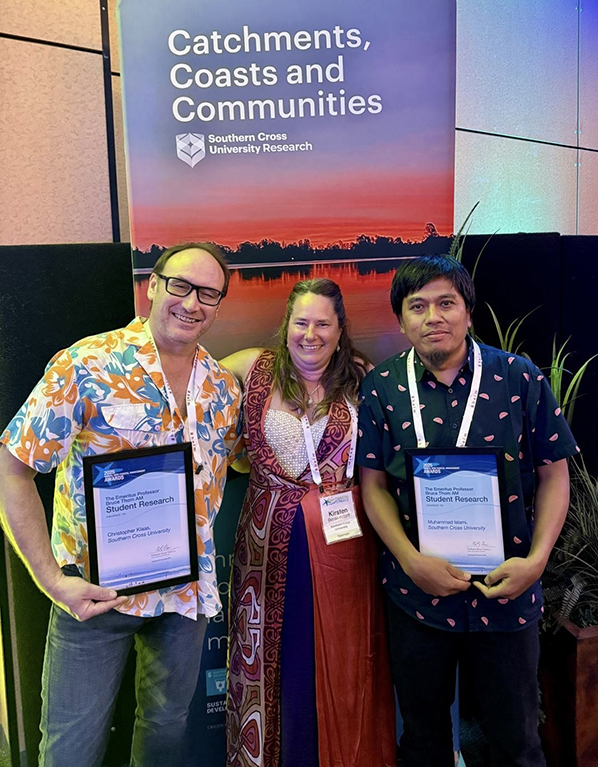
Professor Kirsten Benkendorff (centre) celebrates with her PhD students, Chris Klaas and Muhammad Islami.
Learn more
Leaf oysters: the unsung heroes of estuaries are disappearing, and we know almost nothing about them
Healing the Northern Rivers: the research behind the recovery
Media contact
Sharlene King, Media Office at Southern Cross University +61 429 661 349 or scumedia@scu.edu.au
Keep reading
All Media ReleasesStudents take their learning global in Indonesia
/291x0:910x619/prod01/channel_8/media/scu-dep/news/images/2026/Indonesian-trip---SCU-News-Web-Banner--2000-X-1032-px.png)
From climate resilience to AI innovation, researchers RISE to the challenge
/484x0:1516x1032/prod01/channel_8/media/scu-dep/news/images/2026/RISE.jpg)
Regional Leaders Academy grows Northern Rivers talent pipeline
/484x0:1516x1032/prod01/channel_8/media/scu-dep/news/images/2026/RLA.jpg)
An Honours year in Innovation powers smarter sustainability solutions
/484x0:1516x1032/prod01/channel_8/media/scu-dep/news/images/2026/Emily-Yee.jpg)
How water bugs led Dr Brendan Cox to a PhD
/484x0:1516x1032/prod01/channel_8/media/scu-dep/news/images/2026/Brendan-Cox-SCU-News-Web-Banner-2000-X-1032-px.jpg)
Hard to crack, harder to grow: Southern Cross and Jeju tackle Korea’s macadamia and coffee challenge
/514x0:1487x973/prod01/channel_8/media/scu-dep/news/images/2026/Macadamia-nuts-in-shells_credit-Tony-Wu-Photography-on-Pexels-8162043-2000X973.jpg)
Centenarian ‘earthworm of the sea’ at risk of overfishing
/514x0:1487x973/prod01/channel_8/media/scu-dep/news/images/2026/Steve-Purcell-w-Thelenota-ananas-aka-pineapple-sea-cucumber-off-Lizard-Island-2026-credit-S-Purcell-2000X973-copy.jpg)
Clarence River's largest ever sediment survey delivers baseline results
/484x0:1516x1032/prod01/channel_8/media/scu-dep/news/images/2026/clarence-river.jpg)
Melbourne graduates shine bright
/484x0:1516x1032/prod01/channel_8/media/scu-dep/news/images/2026/SCU-News-Web-Banner-Template-2000-X-1032-px-3.jpg)
Regional marine science gets a bigger role in NSW research network
/484x0:1516x1032/prod01/channel_8/media/scu-dep/news/images/2026/SCU-Marine-partnership-SIMS.jpg)