

Categories
Share
What happens to your health when you never feel safe? How do you settle your nervous system when always forced to think about where you’ll sleep or eat? Southern Cross University Master of Naturopathic Medicine students are gaining a different kind of clinical experience at Fletcher Street Cottage in Byron Bay, working with people experiencing, or at risk of, homelessness.
At Fletcher Street Cottage, appointment calendars give way to casual conversations over breakfast that organically lead into naturopathic consultations.
Student Tahlia Singleton has found herself asking clients, ‘where will you sleep tonight? Will parking under a streetlight keep you awake?’.
Advice that might seem simple in another setting has to work within the reality of someone’s life: try to drink more water, find a nutritious meal and a warmer blanket for a better night’s sleep.
That difference is precisely what Outreach and Engagement Lead at the University’s National Centre for Naturopathic Medicine Isabel Halse was looking for when she helped establish the collaboration with Byron Community Centre, that runs the support centre.
“I wanted to find placement sites that would provide natural care to communities who need it,” Isabel said.
“I was familiar with Fletcher Street Cottage and all the amazing work that they’ve been doing to provide support for our homeless and vulnerable community in Byron Bay.”
Learning from the person in front of you
For Tahlia, the experience has changed her idea of what she needs to offer as a practitioner.
“If you can help in a small way, it actually might go way further than you think,” Tahlia said.
“I don’t need to have all the answers for someone. I just need to be someone that they can talk to and make them feel safe.”
Isabel has supervised three cohorts through the placement and has watched that shift happen.
“It’s been amazing to see their growth. The students feel really fulfilled by being able to provide support and seeing people with such positive outcomes.”
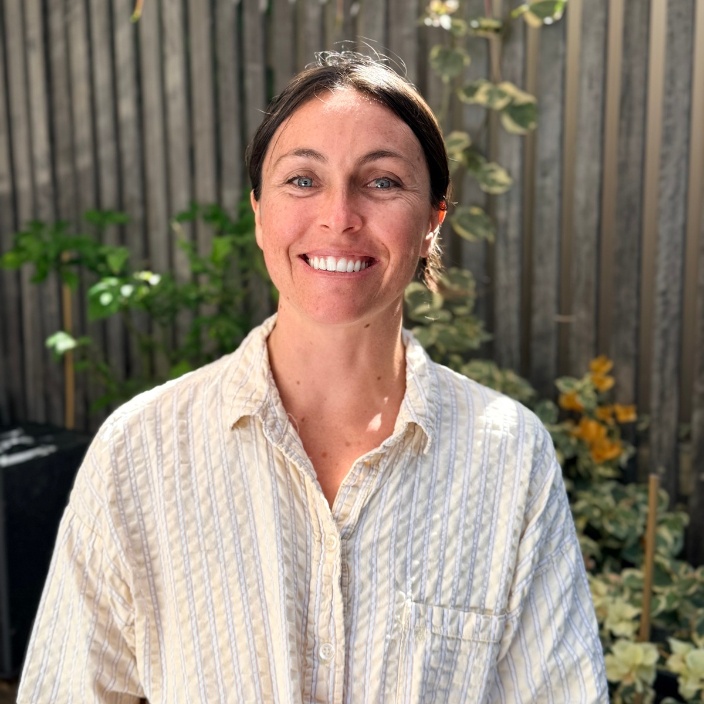
Isabel said Master of Naturopathic Medicine students become more comfortable having difficult conversations and develop greater flexibility in how they respond to the challenging circumstances faced by their clients.
Care that meets people where they are
Fletcher Street Cottage Community Support Worker, Suzanne Flowerday, sees the partnership from the other side.
People coming through the Centre’s doors can be dealing with injuries and wounds and are very often experiencing highly stressed nervous systems. Accessing mainstream health services can be difficult and, for some, confronting.
“For quite a few of our rough sleepers, their preference would be to have natural medicine rather than Western medicine, but they just don’t always have a chance to access that,” Suzanne said.
“They’ve got to walk into a clinic, they might feel unwelcome and they just can’t afford it. So, it’s good for them to have options.”
There is another effect of bringing students into Fletcher Street Cottage that is harder to measure.
“It always gives me hope and really warms my heart when there’s an opportunity for people who wouldn’t otherwise have the opportunity to sit down with somebody who’s unhoused and having really difficult life experiences,” Suzanne said.
She values the chance for students “to see them as a person rather than just a label”.
It may just be the most valuable lesson the students will learn, one that can’t help but mould the professional they will grow into. These very real conversations offer an understanding of vulnerability that could never be taught in a classroom or more traditional clinic setting.
For naturopathy student Jayde Thompson, the experience has built a deeper sense of empathy for people experiencing hardship.
“I feel like that is the most rewarding part, seeing the difference in how people walk in as opposed to how they walk out… just them being listened to and respected and understood. You can actually see the weight lift off their shoulders,” Jayde said.

It always gives me hope and really warms my heart when there's an opportunity to sit down with somebody who's unhoused and having really difficult life experiences, and to have the opportunity to see them as a person rather than just a label.
At Southern Cross University, the Master of Naturopathic Medicine requires you to do clinical placement hours, 80 of which are external. You are required to service vulnerable communities.
Fletcher Street Cottage was established to meet the needs of people who are at risk of homelessness and those who are already sleeping rough in the Byron Shire.
I reached out to Fletcher Street Cottage. I thought it would be great if students could come to provide care to people who would probably never have access to it otherwise.
It's been different to normal placement. Thinking outside the box is very important here. It's the best place to kind of learn those skills.
It has just been super eye-opening to listen to people's stories. It just helps build huge amounts of empathy.
Seeing the difference in how people walk in as opposed to how they walk out, and them just being listened to, respected and understood. You can actually see the weight lift off their shoulders, which is so rewarding.
I think it's great that the students have the chance to sit with a different group of people. Coming here turns it all on its head.
So many people benefit in this relationship, in this collaboration. The students benefit from the learning and the adaptation and the flexibility, thinking critically and outside the box. Then the community benefits. You're supporting people on their journey to stability.
I've seen a lot of growth and I think they always come out at the end much better, well-rounded practitioners.
I have felt very fulfilled. I have found this invaluable.
A partnership finding its feet
The placement has now been running for more than a year, with demand growing as people using Fletcher Street Cottage become familiar with the naturopathy service.
Its growth has also depended on generous industry support. Isabel is particularly grateful to Nutrition Care and Give Back Health, which have donated practitioner-quality products, including herbs and nutrients. The contributions allow students to offer products alongside their recommendations where appropriate, rather than sending someone away with a plan they may be unable to act on.
There is room for that support to grow. For companies considering contributing products, Isabel hopes the placement demonstrates where those donations can end up and the practical difference they can make.
For Isabel, though, the measure of the partnership remains the people on both sides of the consultation.
“It’s incredibly rewarding as a supervisor to see the impact and to build that collaboration and that relationship with Fletcher Street and that trust,” she said.
“The students benefit from the learning, the flexibility, thinking critically and outside the box. But then the community benefits because you’re supporting people's health during their journey to stability.”
“And that’s really powerful.”
Media contact
Keep reading
Read more
Healthy ageing initiative sparks new partnership