
/prod01/channel_8/media/scu-dep/current-students/images/Coffs-harbour_student-group_20220616_33-147kb.jpg)
/prod01/channel_8/media/scu-dep/current-students/services/counselling/images/RS21533_English-College-Student_20191210_DSC_6961-117kb.jpg)
/prod01/channel_8/media/scu-dep/study/scholarships/images/STEPHANIE-PORTO-108-2-169kb.jpg)
/prod01/channel_8/media/scu-dep/study/arts-and-humanities/images/RS20958_Chin-Yung-Pang-Andy_20190309__79I5562-960X540.jpg)
/prod01/channel_8/media/scu-dep/experience/images/SCU-INTNL-STUDY-GUIDE-280422-256-72kb.jpg)
/prod01/channel_8/media/dep-site-assets/component-library/screenshots/online-1X1.jpg)
/prod01/channel_8/media/scu-dep/news/images/2026/Nature-school_credit-Annie-Spratt-on-Unsplash-JUIieIDu54-2000X973.jpg)
Categories
Share
Southern Cross University has partnered with Colac West Primary in rural Victoria to bolster the credentials of the school’s popular bush play-based learning program with outcomes connected directly to literacy, art, science and mathematics.
Dr Chris Speldewinde, a nature-based education expert from Southern Cross University, is leading a team of researchers who are examining the benefits of using play-based teaching and learning in the outdoors to build children’s understanding of the world and enhance student attendance and engagement.
Below: Colac West Primary students Dakota Fortescue (left) and Miriama Tupene at Nature School in Kawarren.
/prod01/channel_8/media/scu-dep/news/images/2026/Nature-School-at-Colac-West-Primary-IMG_0798b-20260605.jpg)
DR CHRIS SPELDEWINDE: Hi, I'm Chris Speldewinde, Dr Chris Speldewinde from Southern Cross University.
ASHLEY KALKANDIS: Hi, my name's Ashley Kalkandis. I'm the principal here at Colac West Primary School. And today we're out in the beautiful Birnam Station for our nature school program. We've been running this program for 3 years now and the biggest benefit we have seen is student engagement. So often on days when we do run our nature school program, there's 100% attendance at our school. It's just fantastic to see how nature school incorporates our school values of responsibility, respect, and resilience and just the appreciation of the natural world around us.
DR CHRIS SPELDEWINDE: I am a researcher and I've been doing work with bush kinders for well over a decade now. And one of the great things that I'm seeing is that bush kinders children 3, 4, 5-year-old who go out into nature once a week. We're now seeing this happening at school which is great. So I'm loving being here with Colac West Primary School because what I'm seeing is the children are learning, they're engaged in nature and the teachers are able to take back what the children are learning back into the classroom and vice versa. So, for example, today it's a beautiful day, there's lots of wind. At the start of today's session, the teachers talked about using the natural resources on the ground to make artwork. And I've seen young children making trees out of tree parts and baskets on the ground. I've seen them talking about things that they can use the tree parts for.
COLAC WEST PRIMARY STUDENTS: I'm Kaisak. I'm Patty. I'm Ashton. I'm Caleb, also known as Club Love.
INTERVIEWER: If you could rate nature school from 1 to 10, what would you rate it?
COLAC WEST PRIMARY STUDENTS: I'd rate it probably a 9. I'd probably rate it a 9.9. [music] I rate it a 10. Getting out of school work. It's good.
INTERVIEWER: No. You're a celebrity. Get on this stage.
Quick facts
Bush schools, Nature play, Outdoor classrooms
Primary school leaders and teachers are realising the benefits of using outdoor play in forest and bush settings to teach children a range of concepts.
An activity like building a cubby house, for example, can be used as an opportunity to teach social skills alongside science and engineering.
Southern Cross University education researchers are partnering with small rural Victorian schools to develop bush school programs.
The research follows previous studies which highlight the benefit of outdoor learning, including ‘Bush Kinder’ programs.
It’s part of a new research project that will see the Southern Cross University team collaborate with six rural schools in the Barwon region to deliver bush school programs that align to the knowledge and skills Victorian students are expected to learn during their schooling.
The schools are Colac West Primary and Forrest Primary where students have been participating in a nature-based program for a few years; as well as Alvie Primary, Lavers Hill K-12, Carlisle River Primary and Deans Marsh Primary where the initiative is new or in development.
“What these small Barwon region schools are doing is cutting-edge and shows a deep commitment to advancing children’s education through facilitating nature play,” said Dr Speldewinde.
“Particularly given we already know how beneficial this type of learning is for younger children’s curiosity about the world and care for a sustainable environment.”
“There’s been a lot of focus in the past decade on early childhood education in forest nurseries and bush kinders .... now to carry this into primary schools adds a whole new dimension to the opportunities for children’s learning.”
/prod01/channel_8/media/scu-dep/news/images/2026/Chris-Speldewinde-46380_High-ASCM7094_Medium.jpg)
Dr Speldewinde has worked with bush kinders since 2015 and, more recently, beach kinders, and urges the same approach be adopted in primary schools.
“Play-based learning in the bush should be incorporated into primary school education in nature-based settings to lay early foundations for a range of learning domains including literacy, art, science and mathematics,” said Dr Speldewinde.
The findings of Dr Speldewinde’s recent research in early childhood education underscores the intrinsic link between children’s exploration of the natural world and their STEM understandings.
In a crowded school curriculum, using natural spaces like forests and parklands gives older children greater chances to explore and link concepts learned in the classroom to real world experiences, according to Dr Speldewinde.
“In at least one school I am working with, a teacher is using a diary where children can reflect on their experiences in the bush school sessions. The children can build on not only their science and mathematics, which is relevant to nature-based education, but can then use literacy and art through writing and drawing to develop their knowledge even further,” said Dr Speldewinde.
“The bush school approach provides our teachers with a complete approach to teaching.”
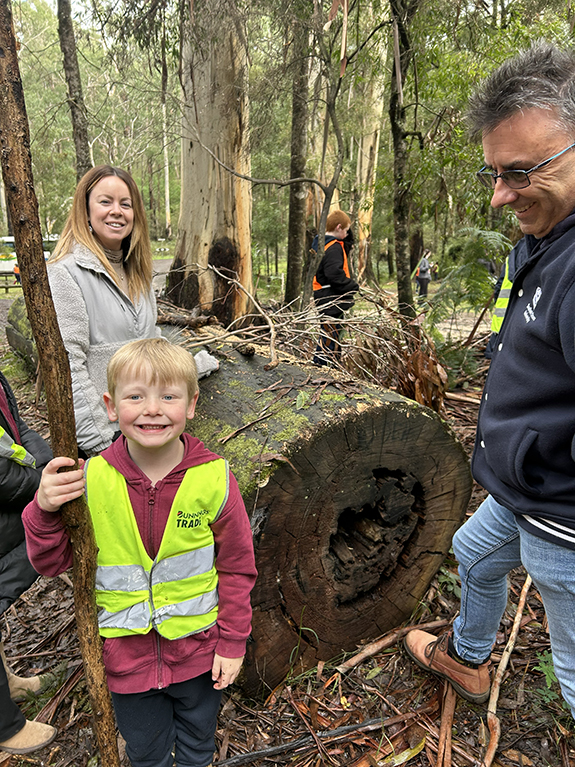
Student Alexander O'Gorman with Colac West Primary School principal Ashley Kalkandis (left) and Dr Chris Speldewinde at the Nature School in Kawarren.
Nature School play making a difference
Mrs Ashley Kalkandis, Principal of Colac West Primary, said she was excited to take up the opportunity to more directly connect the school’s Nature School program, which has been running for three years, with the Victorian curriculum.
“Our school values of respect, responsibility and resilience are consistently reinforced through the program and embedded within authentic, hands-on learning experiences,” said Mrs Kalkandis.
“We have observed increased student attendance on days when Nature School runs. Students who may typically arrive late or experience challenges with attendance are consistently motivated to attend on these days, with attendance often reaching 100%.”
She said she valued the relationship being built between Southern Cross University and Colac West Primary School.
“Working alongside Chris has further strengthened our understanding of how meaningful, real-world learning experiences can engage students and create strong connections to the curriculum in a vibrant and purposeful way,” said Mrs Kalkandis.
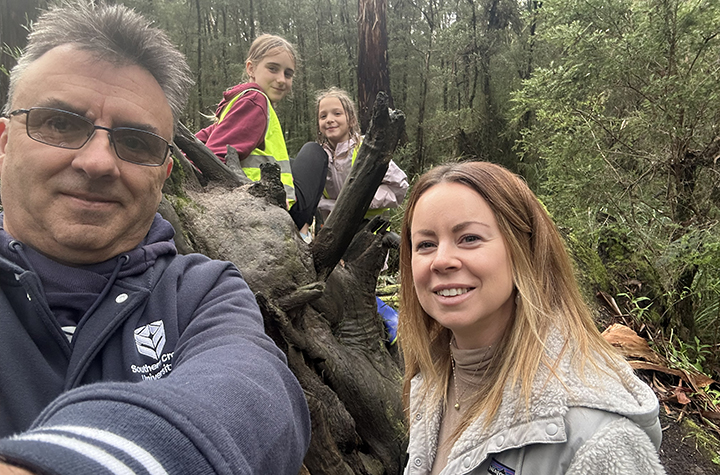
Students Aislin Casey (rear, left) and Kalani Browes with Colac West Primary School principal Ashley Kalkandis (right) and Southern Cross University's Dr Chris Speldewinde at Nature School in Kawarren.
Growing popularity of learning through nature
Bush kinders and bush schools – either standalone programs or programs incorporated into early childhood settings like kindergartens and childcare centres – have been growing in popularity in Australia since the 2010s.
The bush school approach for primary students, however, is less favoured in government schools and more prevalent in independent schools, according to Dr Speldewinde.
“My latest research into beach kinder showed that children aged four and five love being in the outdoors and gain opportunities to apply maths skills such as predicting, inventing and visualising,” said Dr Speldewinde.
The research also showed girls benefit from gender-inclusive spaces and playing with natural materials, or ‘loose parts’, which are the things found on the ground such as sticks, rocks and leaves.
“There’s been a lot of focus in the past decade on early childhood education in forest nurseries and bush kinders. We know these are fantastic learning spaces for children but now to carry this into primary schools adds a whole new dimension to the opportunities for children’s learning,” said Dr Speldewinde.
“Now we need to spend more time conducting research to understand the benefits that older children, six-to-12-year-olds, get by engaging with nature, particularly in learning domains such as literacy, science and maths.”
Media contact
Sharlene King, Media Office at Southern Cross University +61 429 661 349 or scumedia@scu.edu.au