

Share
In 1981, a group of young marine scientists surfaced from a night dive on the Great Barrier Reef after witnessing something that would change our understanding of coral reefs. Forty-five years later, one of the original team members, Southern Cross University Distinguished Professor Peter Harrison, is still following where that discovery leads.
Coral spawning: quick facts
• Corals are animals, not plants. Coral colonies are made up of tiny animals called polyps, which build the limestone skeletons that form reefs.
• What is coral spawning? It is the release of reproductive bundles of eggs and sperm by corals into the ocean, where fertilisation occurs and new coral larvae develop.
• Why does spawning matter? The larvae produced during spawning can settle and grow into new coral colonies, helping replenish and reconnect reef populations after disturbance.
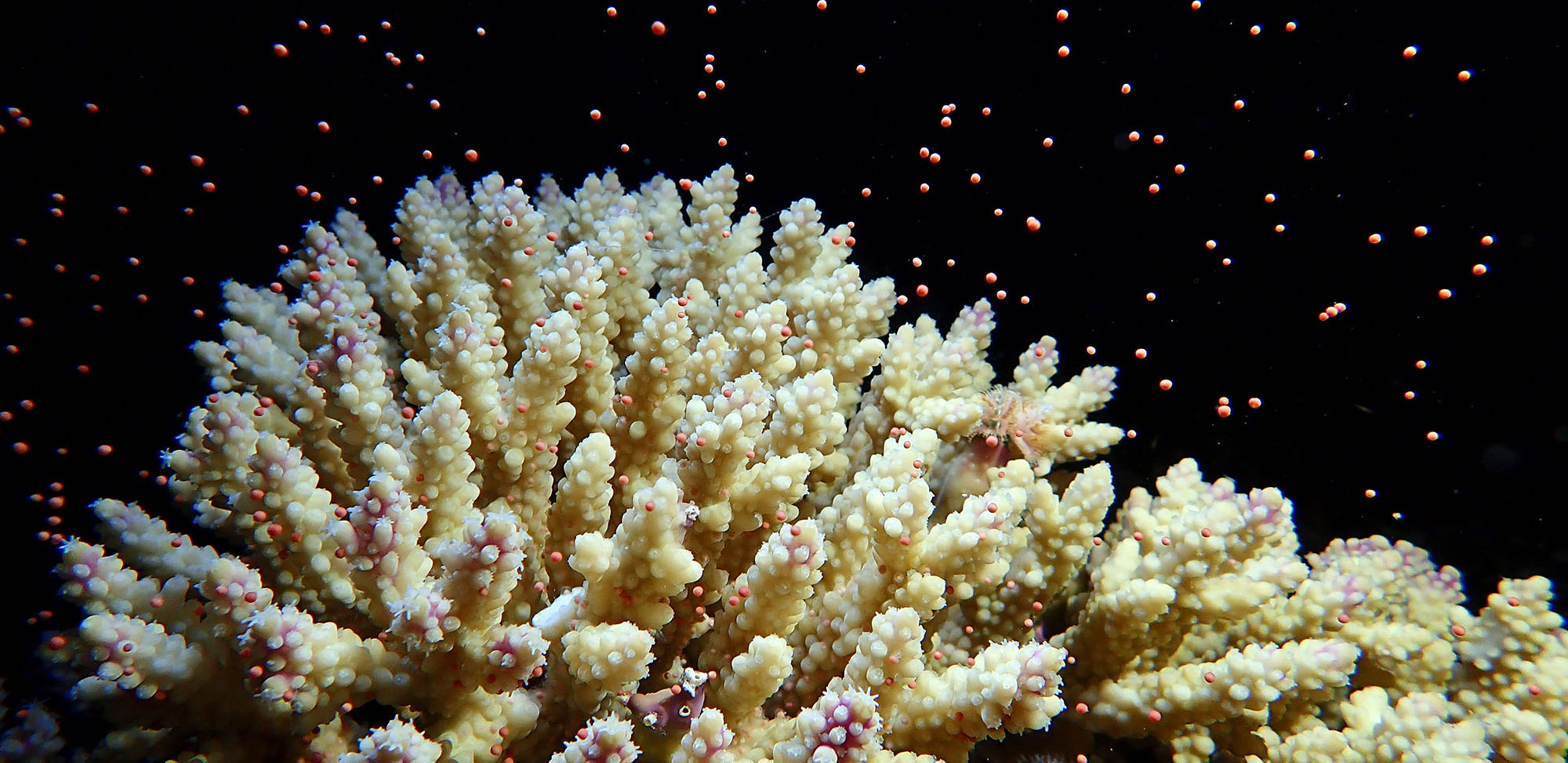
Corals, like this Acropora valida, release reproductive bundles of egg and sperm into the ocean where fertilisation occurs and new coral larvae develop (credit Peter Harrison).
The water around Magnetic Island, off Townsville, was dark except for the beams of dive torches.
Then the reef began to change.
Tiny bundles of eggs and sperm rose from coral colonies into the water above them. More followed, and then more again, until the researchers diving among them were surrounded and enclosed.
“We were diving at night, and we were surrounded by this underwater blizzard of coral spawn rising up from all the colonies we could see,” recalls Distinguished Professor Peter Harrison.
“It was a spectacular event, and I still get overwhelmed by the joy of seeing healthy coral spawn en masse on reefs.”
It was October 1981. Harrison was a young PhD researcher at James Cook University and part of a team trying to answer when and how corals on the Great Barrier Reef reproduce.
What they witnessed at Magnetic Island between 18 and 21 October in 1981 would help rewrite the textbooks.
As the team widened its research, they discovered the event was not confined to one reef. Many coral species synchronised their reproduction across vast stretches of the Great Barrier Reef, releasing their spawn on just a handful of nights each year.
“After the discovery of the mass coral spawning, I was inspired to think about how we could apply that understanding to regenerating corals at scale on damaged reefs”
The work culminated in a landmark 1984 Science paper documenting synchronous multi-species spawning and overturning prevailing assumptions about coral reproduction.
For Professor Harrison, it was also the beginning of a question that would follow him for the next 45 years.
If this was how reefs created new life, could scientists one day harness that process to help damaged reefs recover?
From discovery to restoration
Today, Professor Harrison is a Distinguished Professor at Southern Cross University, recognised internationally for his work in coral reproduction ecology and coral larval restoration.
The natural process he witnessed as a young scientist remains at the centre of his research.
During mass spawning, coral colonies release extraordinary numbers of egg and sperm bundles – scientists count in billions or trillions. After fertilisation, coral larvae develop and drift through the ocean. Some eventually find suitable reef habitat, settle and begin the slow process of forming new coral colonies.
Those larvae are also what connect coral reefs to one another.
The discovery of mass spawning helped scientists understand that the Great Barrier Reef could not simply be thought of as thousands of isolated reefs. Coral larvae can move between reef systems, linking them biologically and ecologically.
Professor Harrison's next leap was to ask whether that same natural reproductive system could be given a helping hand. The result is an approach widely known as Coral IVF.
Rather than fragmenting existing coral colonies, the technique works with their natural sexual reproduction. A small proportion of coral spawn is collected during mass spawning, and the eggs and sperm are transferred into specially designed floating nursery pools. There, millions of genetically diverse larvae can develop before they are released onto damaged reef areas.

After fertilisation, the eggs and sperm in this spawn slick will become coral larvae. This eight-sided floating nursery pool is one of Professor Peter Harrison's designs (credit Juergen Freund).
"After the discovery of the mass coral spawning, I was inspired to think about how we could apply that understanding to regenerating corals at scale on damaged reefs,” Professor Harrison says.
“We then settle those back onto damaged reef sections to kickstart the recovery of the damaged reef areas.”
Over the past decade, the ambition has grown dramatically.
Professor Harrison's team has worked along the length of the Great Barrier Reef, from Heron Island in the south to Lizard Island in the north, and is now capable of producing tens of million to more than one hundred million coral larvae. The techniques are also being applied and adapted internationally, with Professor Harrison working with researchers and communities in the Philippines, Maldives, and emerging work in countries including Indonesia, Madagascar and Kenya. Earlier this year he led restoration efforts at our other iconic reef system Ningaloo in Western Australia.
Southern Cross University is also part of the national Reef Restoration and Adaptation Program, which has spent the past six years developing and testing technologies to help the Great Barrier Reef resist, adapt to, and recover from climate change. Its initial research and development phase concluded in June 2026, and the challenge now is taking promising approaches from research into increasingly large real-world deployments.
For Professor Harrison, it is a remarkable evolution of an idea that began in a cloud of coral spawn 45 years ago. But it is also a race against a changing reef.
“What is Coral IVF? A restoration technique that collects coral spawn, grows the resulting larvae in specially designed pools, then releases them onto damaged reefs to help new corals establish.”
A reef of different futures
Professor Harrison has spent enough time underwater to resist simple descriptions of the Great Barrier Reef as either healthy or dying.
Instead, he describes what he sees today as a “mosaic.”
Some reefs remain beautiful and healthy. Some have been damaged but are recovering naturally. Others are being hit again before that recovery can take hold and remain degraded.
That distinction matters.
Natural reproduction remains the most powerful restoration system available. A mass spawning event can generate billions of larvae without any human intervention. The role of science, Professor Harrison argues, is not to replace that process everywhere, but to understand where natural recovery is working, and where a carefully targeted intervention could make a difference.
“Some of those reef systems are recovering naturally through sexual reproduction and mass spawning, generating billions of larvae,” he says.
“However, some of these reef systems are not recovering naturally, which is why we need to think about how to sensibly intervene.”

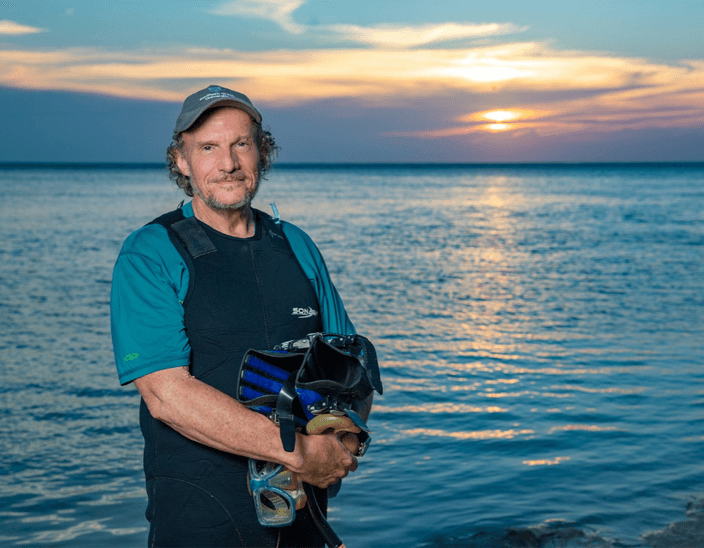
Distinguished Professor Peter Harrison diving at North Point off Lizard Island.
That question is becoming increasingly important as Australia reviews the Reef 2050 Plan, the overarching long-term sustainability framework guiding how the Australian and Queensland governments protect and manage the Great Barrier Reef.
Among its priorities are rehabilitation and restoration, climate action, water quality, and the management of other pressures.
At the same time, reef restoration science is moving into a new phase.
Large-scale pilot deployments are now testing how restoration techniques can work beyond individual research sites, including the people, infrastructure, technology and supply chains that would be required if intervention were ever needed across much larger areas.
Professor Harrison says it is about working out where producing more coral larvae can have the greatest effect.
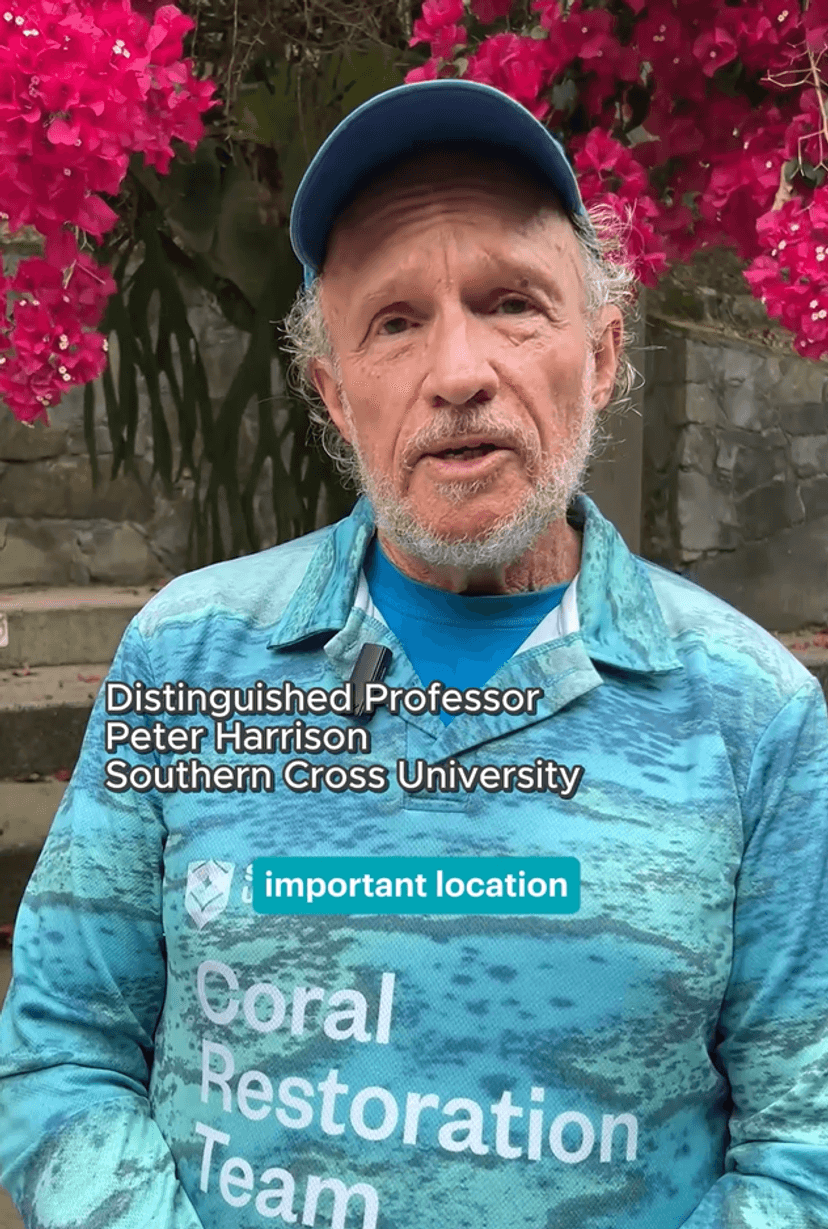
“A healthy reef capable of regenerating itself may need little or no assistance. A damaged but strategically important reef that has lost too many breeding corals could be a very different proposition,” he says.
“Protecting surviving corals, maintaining genetic diversity and restoring reproductive populations could, in turn, help generate larvae for neighbouring reefs.
It shifts the question from whether humans should attempt to rebuild the Great Barrier Reef to one where “science can help natural recovery continue.”
Buying time, not replacing climate action
There is one point Professor Harrison is emphatic about.
Restoration cannot solve climate change.
The Great Barrier Reef Marine Park Authority continues to identify climate change as the Reef's greatest threat, while increasingly frequent and cumulative disturbances leave coral communities less time to recover between events.
And the next test may not be far away. A strong El Niño is established in the tropical Pacific, with the Reef Authority warning of a potential marine heatwave from December as the Great Barrier Reef enters another summer.
Professor Harrison sees interventions such as Coral IVF as a way of strengthening the Reef's capacity to recover while the much larger work of reducing global warming continues.
“The reality is that unless we transition quickly from burning fossil fuels to renewable energy, we will see increasing death and destruction on the Great Barrier Reef and all reefs globally,” he says.
That tension – between optimism in what science can achieve and realism about what it cannot – has come to define the next phase of his work.
Forty-five years ago, Harrison and his fellow researchers discovered an extraordinary mechanism for renewal.
Today, his work focuses on keeping that mechanism functioning.
Each spawning season still brings the spectacle that first captivaed him: billions of potential new corals rising towards the surface on a handful of nights beneath the moon.
For Harrison, those nights are a reminder that the Reef is still trying to rebuild itself.
The question for the next 45 years is how much help it will need.