
/prod01/channel_8/media/scu-dep/current-students/images/Coffs-harbour_student-group_20220616_33-147kb.jpg)
/prod01/channel_8/media/scu-dep/current-students/services/counselling/images/RS21533_English-College-Student_20191210_DSC_6961-117kb.jpg)
/prod01/channel_8/media/scu-dep/study/scholarships/images/STEPHANIE-PORTO-108-2-169kb.jpg)
/prod01/channel_8/media/scu-dep/study/arts-and-humanities/images/RS20958_Chin-Yung-Pang-Andy_20190309__79I5562-960X540.jpg)
/prod01/channel_8/media/scu-dep/experience/images/SCU-INTNL-STUDY-GUIDE-280422-256-72kb.jpg)
/prod01/channel_8/media/dep-site-assets/component-library/screenshots/online-1X1.jpg)
GenAI in Learning and Teaching
/prod01/channel_8/media/scu-dep/staff/teaching-and-learning/mastheads/GenAi-masthead-bgd.jpg)
At Southern Cross University, we are committed to harnessing the transformative potential of Generative AI (GenAI) for our students and staff.
As students learn in the Southern Cross Model, we want them to use, understand and critique GenAI, in ways that are authentic and integral to their future careers. We will help students do that.
Students will be exposed to GenAI in a variety of ways across their SCU journey, through teaching, assessment, feedback, research, and navigating their unit content.
At SCU, we take a “first principles approach” in recognising that GenAI is a software that is not inherently good or bad and is a tool that can be used constructively to enhance students' and academics' efficiencies in the way they learn and teach.
SCU has adopted a policy that supports and encourages the use of GenAI where it does not pose an unacceptable risk to the assurance of academic standards and integrity.
SCU believes in the benefits GenAI will produce for students and staff and has committed to providing an educative approach to mitigate the risks of using Gen AI tools in inappropriate or unethical ways.
See the GenAI workshops below for upcoming GenAI training.
Logging in to MS Copilot
By using your SCU login to MS Copilot, some of these security issues are mitigated as the data is not stored and is not used to train the model/s.
Explore Generative Artificial Intelligence (GenAI) in Learning and Teaching at SCU
This resource provides SCU academics with recommendations for using Generative Artificial Intelligence (GenAI) in learning, teaching and assessment within the context of the University’s policies, procedures and guidelines.
Generative Artificial Intelligence (GenAI) refers to systems that can create new content such as text, images, audio, video, or computer code (Feuerriegel et al., 2024). These systems typically learn patterns from existing data and use them to generate outputs that appear novel and meaningful. For example, Large Language Models (LLMs) can produce human-like text, while diffusion models and Generative Adversarial Networks (GANs) can create realistic images, audio, or video.
Different types of GenAI serve different purposes:
- LLMs generate and process text or code.
- Diffusion models and GANs generate visual, audio, or multimedia content.
At SCU, students and staff are encouraged to use only university-approved GenAI tools. This ensures that personal and institutional data are handled responsibly and not exposed to unauthorised use.
For further information on GenAI in education see:
- Guidance for generative AI in education and research (UNESCO, 2023)
- Generative AI and ChatGPT: Applications, challenges, and AI-human collaboration (Nah, et al., 2023)
- ChatGPT: Bullshit spewer or the end of traditional assessments in higher education? (Rudolph. et al., 2023)
Tertiary Education Quality and Standards Agency (TEQSA) outlines directions for the future assessments providing guiding principles and propositions for higher education assessment and artificial Intelligence. Assessment Reform for the age of Artificial Intelligence.
The Australian Academic Integrity Network (AAIN) provides guidance on the appropriate use of generative AI in higher education, aligned with the Higher Education Standards Framework (1.4.4) See AAIN Generative Artificial Intelligence (AI) Guidelines.
TEQSA provide resources responding to advances in GenAI, including policies, upholding academic integrity, engaging with students, assessment design and using AI to support teaching and learning, in their higher education good practices hub. https://www.teqsa.gov.au/guides-resources/higher-education-good-practice-hub/gen-ai-knowledge-hub
SCU’s approach is consistent with these guidelines and practice recommendations.
SCU is taking a “first principles approach” in recognising that GenAI software is not inherently good or bad and is a tool that can be used constructively to enhance students' and staff's efficiencies in the way they learn and teach. The approach to the use of GenAI tools at SCU is based around the following:
- appropriate use of GenAI technology is supported and encouraged;
- use of GenAI technology is prohibited when it would pose an unacceptable risk to assurance of academic standards and integrity; and
- suitable measures will be employed to educate about the benefits and mitigate against the risks of using GenAI technology.
- Download Generative AI Guardrails for Use at SCU - This document outlines key guardrails to prevent the sharing of sensitive information, including institutional, financial, and personal data.
- Find out more from CTL Knowledge base
- Use the GenAI Tool Use Descriptors Guide to assist you.
- For students, the SCU Library Guide on GenAI is a helpful resource.
The GenAI Tool Use Descriptors Guide for staff and students is a collaboratively developed resource aimed at providing clarity around the appropriate use of Generative Artificial Intelligence (GenAI) tools in academic assessments. This set of descriptors outlines the varying levels of permissible GenAI use, ranging from full integration to restricted or no use, ensuring that students understand the expectations of use for assessments and maintain academic integrity.
Additionally, an infographic has been designed to make the guidelines more accessible and easy to understand.
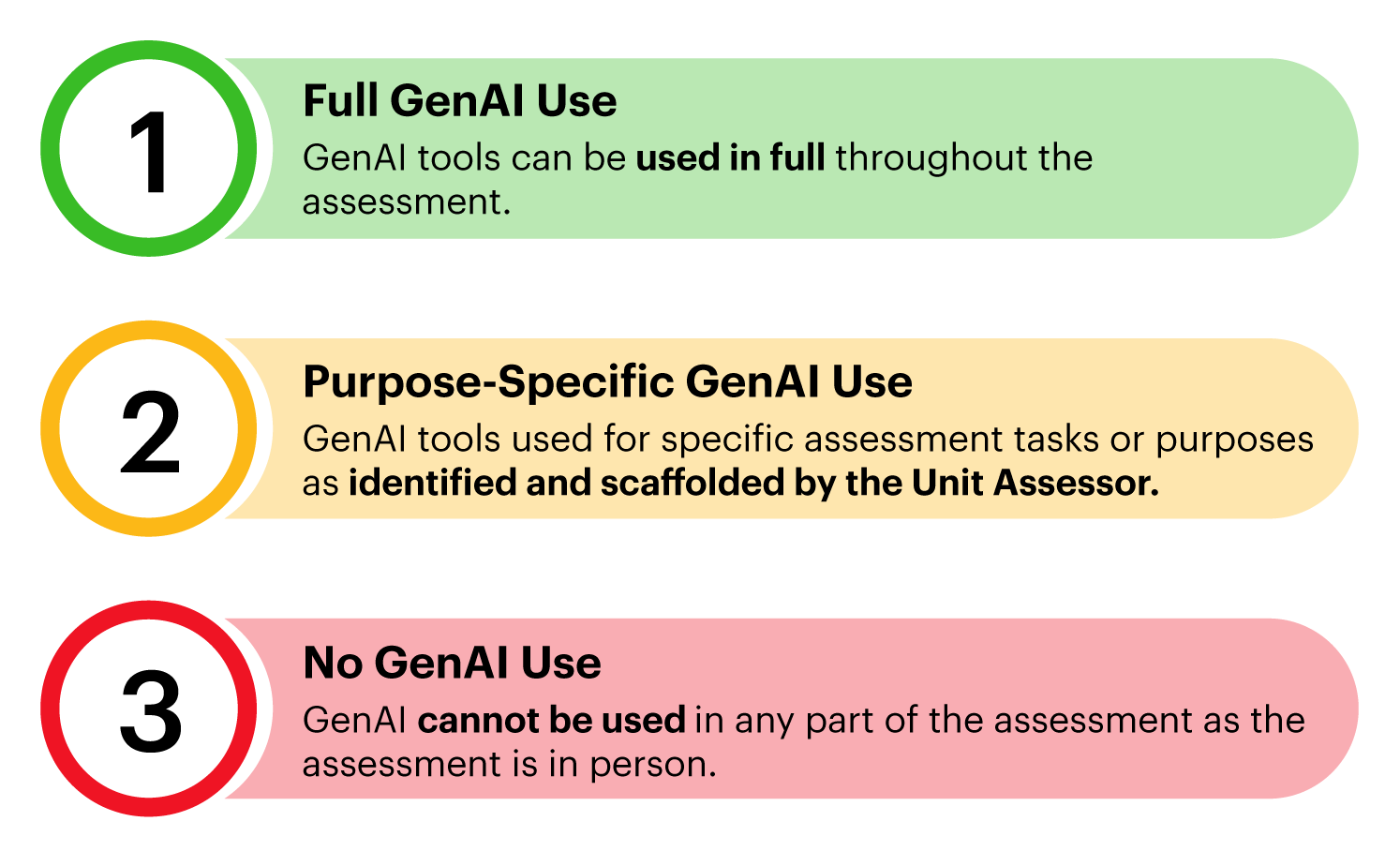
The descriptors guide students on the specific contexts in which GenAI tools, such as Grammarly or ChatGPT, may be used, while also clarifying what constitutes academic misconduct. There are three distinct categories of GenAI use, from full use throughout an assessment to complete restriction, depending on the nature of the task and information provided in the unit by the UA. Students must be able to demonstrate adherence to these guidelines, particularly when GenAI tools are permitted.
This resource is valuable for both students and staff, with staff receiving complementary guidelines to aid in teaching and supporting students in the appropriate application of GenAI technologies. It helps foster a clear, shared understanding of how to ethically and effectively use these emerging technologies in an academic setting.
Download GenAI Tool Descriptors for Staff
Considering GenAI in assessment design
The following resource, the Assessment Adaptation Model-GenAI (AAM-GenAI), provides a step-by-step guide for considering GenAI in the assessment design cycle. The resource incorporates current practice recommendations in higher education and SCU policy, and procedure requirements for academic integrity and assessment. The approach also supports students' digital literacy development in a GenAI-enabled world.
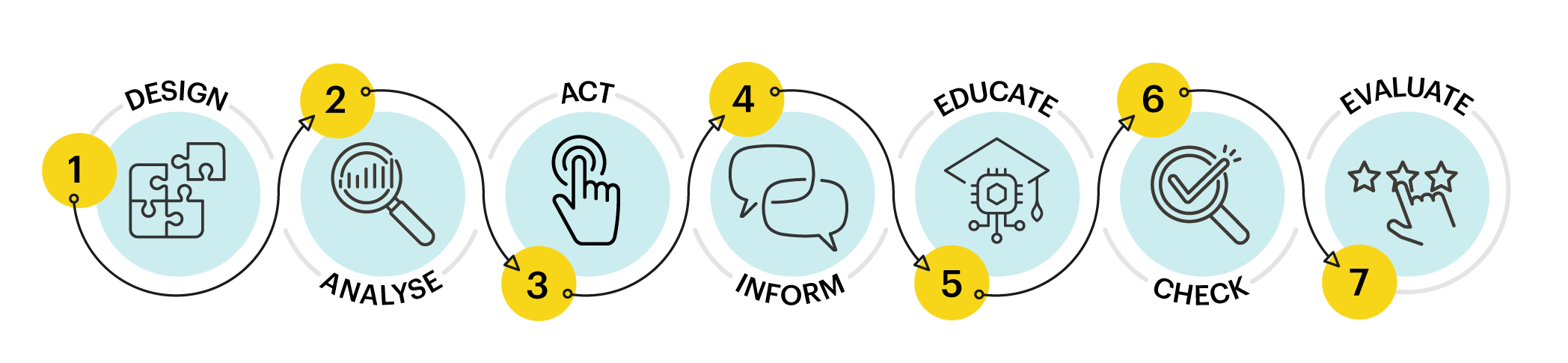
Image: Assessment Adaptation Model-GenAI (AAM-GenAI)
Find out more about adapting your assessment for GenAI.
/prod01/channel_8/media/scu-dep/staff/teaching-and-learning/column-gfx/GenAi-workflow-design-label-callout-415X374.png)
Design
Where you have sufficient time to design assessments from scratch or completely rethink your assessment, consider what task would mitigate potential risks associated with GenAI use and how you might include acceptable use of GenAI by students in the task design.
Start here when you have a longer timeframe, and it is possible to design the assessment from scratch or fully redesign the assessment.
/prod01/channel_8/media/scu-dep/staff/teaching-and-learning/column-gfx/GenAi-workflow-analyse-label-callout-415X374.png)
Analyse
Where your assessment is already designed and you do not have capacity for major changes, look at your current assessment and determine how it holds up if GenAI tools were used to complete the task.
Start here where you have a shorter timeframe and there is insufficient time for a major redesign of assessment.
/prod01/channel_8/media/scu-dep/staff/teaching-and-learning/column-gfx/GenAi-workflow-act-label-415X288.png)
Act
After analysing the assessment, if concerns arise about academic rigour or integrity with GenAI use, consider the modifications you can make to the task instructions and what limits to GenAI use you need to define and implement to mitigate risks.
View Act resource/prod01/channel_8/media/scu-dep/staff/teaching-and-learning/column-gfx/GenAi-workflow-inform-label-415X288.png)
Inform
Now that you have reviewed your assessment and decided on what would be acceptable or unacceptable use of GenAI you need to clearly and explicitly communicate this to students.
View Inform resource/prod01/channel_8/media/scu-dep/staff/teaching-and-learning/column-gfx/GenAi-workflow-educate-label-415X288.png)
Educate
As an Academic at SCU it is your responsibility to educate students on the ethical and responsible use of GenAI. Direct them to available support resources and foster an environment for students to ask questions about acceptable and unacceptable GenAI use to help reduce the risk of academic integrity breaches in assessment.
View Educate resource/prod01/channel_8/media/scu-dep/staff/teaching-and-learning/column-gfx/GenAi-workflow-check-label-415X288.png)
Check
As the Unit Assessor or Marker, review the assessment you are grading for signals of GenAI use beyond the defined acceptable limits identified in the assessment brief, adhering to SCU guidelines.
View Check resource/prod01/channel_8/media/scu-dep/staff/teaching-and-learning/column-gfx/GenAi-workflow-evaluate-label-415X288.png)
Evaluate
Engage in reflective practice to gain insights for future assessments. This evaluation should encompass broader assessment improvements and innovative approaches for incorporating GenAI into learning and assessment practices.
View Evaluate resource/prod01/channel_8/media/scu-dep/staff/teaching-and-learning/column-gfx/genai-video-2-thumbnail-415X233.png)
In this video, we introduce the Assessment Adaptation Model-GenAI.
This resource provides a guide for considering GenAI in assessment design at SCU.
We will show you how the Assessment Adaptation Model is organised and how it is intended to be used.
The Assessment Adaptation Model- GenAI steps through the assessment cycle, providing practice recommendations around GenAI within the context of SCU requirements.
In the design step, we design an assessment from scratch, considering all elements of best practice in assessment design, including GenAI resilience.
Analyse is where we follow steps to check an assessment for GenAI resilience.
Act is when we set boundaries for GenAI use in an assessment and mitigate any threats to academic integrity.
The next step is to inform students about the limits of GenAI use in their assessment.
Educate is where we find ways to develop students’ GenAI skills with the unit’s teaching and assessment.
Check is carried out during assessment grading, where we look for signs of unacceptable GenAI use.
Evaluate is where we reflect on the assessment and consider whether changes may be required in future iterations. This evaluation will inform the ‘design’ step should changes be required, which restarts the cycle.
Depending on where you are in the assessment design cycle, or how long before your unit opens to students will determine where you should start.
We define a long timeframe as being when you still have the capacity to change UCMS information, such as the ULOs or assessment type or length. In that instance, you will start with the ‘design’ step.
A short timeframe is when the UCMS deadline has passed and changes for the current assessment cycle are no longer possible. In that instance, you would start with the ‘analyse’ step.
This link will take you to the knowledge base for considering generative artificial intelligence in assessment design where we introduce the Assessment Adaptation Model-GenAI.
These links will take you to each of the knowledge bases where you can find detailed information for each step of the Assessment Adaptation Model- GenAI.
Within the knowledge base, you can also navigate to the individual page for each step by clicking on the relevant icon.
At each step, you will be guided through practice recommendations and SCU requirements for considering the use of GenAI and adapting the assessment and unit teaching accordingly.
It’s important to keep in mind that GenAI capabilities are evolving rapidly. We can’t possibly stay ahead of it, or even know exactly which GenAI tools students are using. The best we can do is take the necessary steps to maintain academic standards while staying flexible in our approach and focusing on helping students use GenAI ethically and in ways that are authentic to their professions.
Introducing the Assessment Adaptation Model - GenAI
This video gives an overview of the AAM-GenAI resource, and its intended use for providing practice recommendations within the context of SCU’s requirements.
SCU GenAI related resources
| Policies, Procedures and Guidelines | Guides and Knowledge base articles | GenAI in Scholarship of Learning and Teaching |
|---|---|---|
| Date recorded | Details | Recording Link | |
 |
08/07/25 15/07/25 22/07/25 |
GenAI Training for Teaching and Learning workshop series6 workshopsOnline & F2F in Lismore - (08/07/25 22/07/25 concluded), 05/08/25 Presenter: Zach Quince, Centre for Teaching and Learning CTL is pleased to announce a new advanced professional development module on Generative AI. Following on from the foundational training, this session offers a deeper dive into practical application and pedagogical design. It provides hands-on guidance for redesigning assessments to be more resilient and meaningful using Southern Cross University’s key frameworks, including the Assessment Adaptation Model (AAM-GenAI) and the GenAI Tool Use Descriptors. This is a valuable opportunity to ensure your teaching practices are aligned with institutional guidelines while preparing students for an AI-integrated professional world. The six sessions advance your skills in navigating Generative AI in higher education with this practical workshop. Moving beyond the basics, this session provides concrete strategies to confidently manage GenAI in your teaching. You will learn to design robust assessments using Southern Cross University's official Assessment Adaptation Model and apply the GenAI Tool Use Descriptors to set clear student expectations. The training focuses on guiding students in the ethical use of AI tools, fostering evaluative judgment, and incorporating reflective practices to maintain academic integrity while preparing students for an AI-enabled future. |
|
|
21/05/25 |
Smarter Support - Personalising education through chatbots Dr Vinh Bui (Faculty of Science and Engineering) (Showcase 1 2025 - Presentation 4) |
View recording |
|
21/05/25 |
Finding the sweet spot - Helping students avoid the twin pitfalls of overcaution and overconfidence in GenAI: Insights from a collaborative approach to GenAI literacy Ms Suzanne Rienks (Study Well), Ms Cintamani Brown (SCU Library), Ms Jenny Luethi (SCU Library) (Showcase 1 2025 - Presentation 2) |
View recording |
|
21/05/25 |
Using GenAI-simulated business roles to build authentic analysis skills in the Southern Cross Model Dr Carolyn Seton (Faculty of Science and Engineering) (Showcase 1 2025 - Presentation 1) |
View recording |
|
29/05 |
Teach Smarter, Not Harder: Andy’s top tips for GenAI tools at SCUAndy Smidt shows you her favourite and newest GenAI tools. Discover how these tools can transform the way you work, teach, and connect with students. In this practical and engaging session Andy will show you a range of GenAI tools that can save time, reduce repetitive tasks, and enhance creativity. Whether you're looking to streamline admin tasks, create engaging teaching materials, or simply add a bit of fun to your workflow, there's something here for everyone. Andy will show you what she does with each tool so that you will go away with practical “how to” tips. No prior tech skills required—just curiosity and an open mind. |
View Recording |
|
01/08/24 |
Introduction to Generative AI (A practical introduction for beginners)
Presenter: Marlon Jones (he/him), Educational Designer, Centre for Teaching and Learning This workshop provides a non-technical introduction to AI fundamentals tailored for those beginning their AI literacy journey. It is designed to help both teaching and non-teaching staff understand the basics of Generative AI (GenAI) and explore its potential applications in an educational setting. Through this interactive session, you'll gain a foundational understanding of GenAI, explore popular GenAI tools, and learn practical prompts to enhance your daily productivity. We'll also discuss important security considerations and provide access to curated AI resources to support your continued learning. Recorded in Zoom 1st August 2024 Supporting resource: Introduction to Generative AI workshop - supporting PPT slides |
View Recording |
|
06/03/24 |
Gen AI for Development and DeliveryIn this one-hour session, Chris Lawler will share her principles developed while course writing and as a Unit Assessor providing feedback to students. The use of cutting-edge technologies like generative AI (LLMs) has the power to significantly enhance the quality and efficiency of course development and delivery. |
View Recording |
|
21/06/23 |
Emerging Practices for Generative Artificial Intelligence: SCU policy guidelines and practiceDot Armstrong (PVC Academic Quality), Dr Jenelle Benson (Centre for Teaching and Learning), Dr Aspa Baroutsis (Education), and A/Professor Mandy Shircore (Law). |
View Recording |
|
7 - 8/11/23 |
Let's talk about Generative Artificial Intelligence (GenAI) developments and ethical considerations
Round table discussion Recorded during SoLT Symposium 2023 |
View Recording |
|
7 - 8/11/23 |
GenAI in the ClassroomDr Ali Reza Alaei, Faculty of Science and Engineering and Dr Fahimeh Alaei, Faculty of Science and Engineering Recorded during SoLT Symposium 2023 |
View Recording |
|
7 - 8/11/23 | GenAI for academics: Siri and Alexa, meet Samantha and HALDr Paul A Whitelaw (PhD): Educational Partnerships Board - The Hotel School Recorded during SoLT Symposium 2023 |
View Recording |
|
7 - 8/11/23 |
Multiple choice tests: Efficient assessment and effective pedagogy in the age of 6-week termsDr Paul A Whitelaw (PhD), Educational Partnerships Board - The Hotel School Recorded during SoLT Symposium 2023 |
View Recording |
|
7 - 8/11/23 |
Designing authentic assessment in the era of GenAI: A support resource for academicsDr Joanne Munn, Dr Jenelle Benson, Dr Anu Khara, Janette Ellis and Jessica Mills, Centre for Teaching and Learning Recorded during SoLT Symposium 2023 |
View Recording |
CTL upcoming GenAI workshops
View all eventsApplying to become an HEA Associate Fellow or Fellow
14 April 2026/484x0:1516x1032/prod01/channel_8/media/scu-dep/staff/teaching-and-learning/events/CTL_workshops_Events-masthead-teal-with-bgd-2000X1032.jpg)
Applying to become an HEA Senior Fellow
16 April 2026
Being an HEA mentor
21 April 2026