




Earth Sciences research
Research in Earth Sciences has never been more crucial than now.
In a world of climate change and ecological crisis, it is important that we understand our natural world and all of its species, ecosystems, elements and environment. As world leaders in Earth Sciences, Southern Cross University is passionate about helping individuals and teams from our research centres and specialised groups enter the field and start their journeys as researchers.
Explore:

“Southern Cross University research applies innovative scientific approaches to some of the biggest environmental issues facing the world. Global warming, rising salinity and acidity, species vulnerability, and the search for more efficient and less damaging methods in agriculture, mining and forestry are all key areas of our research, teaching and learning. Our Faculty of Science and Engineering has more than 30 years of excellence, resulting in our outstanding international research profile. Our focus is always on the future, especially as it relates to the protection and restoration of ecosystem services, and our ability to sustain future generations.”
Excellence in Research (ERA) 2018 national report results
‘Well above world standard’
ERA Rating 5 in Earth Sciences (04)
‘Well above world standard’
ERA Rating 5 in Oceanography (0405)
‘Above world standard’
ERA Rating 5 in Environmental Science and Management (0502)
Key research Areas of Excellence
Southern Cross University delivers internationally recognised research in Environmental Sciences, specialising in fields of biogeochemistry, ecology and management of catchments, wetlands, floodplains, coral reefs and coastal systems, working in close collaboration with DPI, state and federal agencies, ANSTO, Aboriginal Corporations, industry and community partners. Southern Cross is rated well above world standard in Earth Sciences, Geochemistry, Environmental Science and Management, and Ecology.
| Area | Academic |
|---|---|
|
Aquatic and Coastal Biogeochemistry: Carbon, nitrogen and nutrient cycling across the land–ocean continuum, spanning groundwater, rivers, estuaries, mangroves and shelf waters. Research combines high-resolution field observation, natural radioisotope and geochemical tracers, automated flux systems and compound-specific and isotope process studies to quantify sources, transformations and export. Applications include eutrophication and nutrient over-enrichment, submarine groundwater discharge, sediment and porewater dynamics, and the biogeochemical response of coastal systems to floods, fire, drought and land-use change. |
Damien Maher, Bradley Eyre, Joanne Oakes, Dirk Erler, Judith Rosentreter, Douglas Tait, Luke Jeffrey, Jacob Yeo, Mitchell Call, James Sippo |
|
Greenhouse Gases, Wetlands and Blue Carbon: Measurement and upscaling of methane, carbon dioxide and nitrous oxide emissions from wetlands, floodplains, estuaries, reservoirs and coastal waters, including vegetation and tree-mediated methane transport and the microbial ecology of bark. Blue carbon research addresses sediment carbon accumulation, export and carbon burial in mangrove and saltmarsh systems, paired radiocarbon and lead-210 dating of carbon stores, and reconciliation of bottom-up flux measurements with national inventory and satellite-based estimates. |
Luke Jeffrey, Judith Rosentreter, Damien Maher, Bradley Eyre, James Sippo, Scott Johnston, Douglas Tait, Jacob Yeo, Christian Sanders |
|
Environmental Geochemistry, Soils and Contaminants: Redox-driven geochemistry of iron, sulphur, arsenic, chromium and trace metals in soils, sediments and waters, with long-standing strength in coastal acid sulphate soils and their remediation. Research applies synchrotron-based spectroscopy, mineralogical characterisation and porewater and groundwater analysis to resolve contaminant speciation, mobility, flux and fate. Work extends to legacy mine sites, waste-derived materials and the geochemical constraints on resource recovery and the circular economy. |
Edward D Burton, Scott Johnston, Amanda Reichelt-Brushett, Lachlan Yee |
|
Ecotoxicology, Water Quality and Catchment Management: Ecotoxicology of metals and emerging contaminants in tropical and temperate aquatic systems, including sensitivity of early life stages and the development of sediment and water quality guidelines. Catchment-scale research addresses nutrient, pesticide and sediment run-off, groundwater contamination, fertiliser mitigation, and rehabilitation and restoration of degraded waterways, with strong translation into regulatory guidance, remediation practice and large-scale citizen science monitoring programs. |
Amanda Reichelt-Brushett, Dirk Erler, Scott Johnston, Damien Maher, Douglas Tait, Kirsten Benkendorff |
|
Ecology, Biodiversity and Landscape Change: Ecology and conservation of terrestrial, freshwater and marine fauna. Terrestrial research includes amphibian and reptile ecology in subtropical rainforest and upland systems, and the captive breeding and conservation translocation of endangered Gondwanan frogs supported by range contraction modelling and passive acoustic monitoring. Marine research addresses coral reproductive biology, coral spawning and larval ecology, and the development and scaling of larval-based reef restoration applied to reef recovery following mass bleaching and cyclone disturbance. Entomological research addresses insect responses to extreme events and a changing climate, dung beetle ecology across grazing and native forest systems, and the ecology and management of invasive and pest species, including critical assessment of broadcast baiting and integrated pest management strategies and expert advice to national inquiries. Biodiversity assessment increasingly draws on environmental DNA, including the first DNA-based mapping of biodiversity across NSW estuaries, alongside coastal geomorphology, Quaternary landscape and sea-level change, remote sensing and spatial modelling. |
Nigel Andrew, David Newell, Peter Harrison, Marie-Chantale Pelletier, Debra Stokes, Liam Bolitho |
| Geochronology, Palaeoenvironments and Human Evolution: Dating and geochemical analysis of fossil and geological materials to reconstruct past environments and hominin life history, including uranium-series and electron spin resonance dating and laser-ablation ICP-MS of teeth and biogenic materials to resolve growth, diet, mobility and weaning in early humans and extinct fauna. Related work addresses Quaternary landscape and sea-level change, coastal geomorphology and long-term environmental records. | Renaud Joannes-Boyau, Anja Scheffers |

Secrets of a natural wonder
Kati Thanda-Lake Eyre inspires modern explorers
When Kati Thanda-Lake Eyre filled with floodwaters in April, 2019, modern-day explorers Professor Bradley Eyre and Professor Dirk Erler went to central Australia for a scientific first – to measure its greenhouse gas emissions.
Among their questions were: Are emissions from inland-draining dryland lakes and river systems different to other lakes and rivers? And could these systems – already suspected as sources of greenhouse gases – also act as a ‘sponge’ for greenhouse gases?
The two researchers from Southern Cross University’s Centre for Coastal Biogeochemistry took water samples at points along the catchment and shore of Kati Thanda-Lake Eyre and its associated river systems.
“Natural greenhouse gas emissions from lakes and rivers make a significant contribution to the global greenhouse gas budget,” says Professor Eyre – who is no relation to European explorer Edward Eyre for whom Lake Eyre was named by Europeans.
“However, every other major river drainage basin on this continent goes out to sea, except the Lake Eyre Basin, which drains inland.”
Associate Professor Erler said that aquatic systems are the largest source of methane and that increasing methane concentrations in the atmosphere accounted for around 20 per cent of global warming to date.
“These inland systems are so vast that even small changes in greenhouse gas flux can have an enormous impact,” he says.
The research forms part of the Centre for Coastal Biogeochemistry’s greenhouse gas work, including estuary research in Queensland funded by the Australian Research Council.
More inspiring work
Firefighters’ health in focusResearch highlights:
|
Macadamias on the mapResearch highlights:
|
Optimising beekeeping in the Indo-PacificResearch highlights:
|
Vanuatu initiative is the ultimate tree changeResearch highlights:
|
Koalas on the move: Going the distance for habitatResearch highlights:
|
The lay of the land: Australian farmers tell their storiesResearch highlights:
|
Mountain frogs go on the recordResearch highlights:
|
Bridging the knowledge gap on hempResearch highlights:
|
Pacific program changes lives for rural womenResearch highlights:
|
Connecting industrial waste to food securityResearch highlights:
|
Coastal care: Carbon project is working for our wetlandsResearch highlights:
|
Human nature
Rethinking our evolutionary history
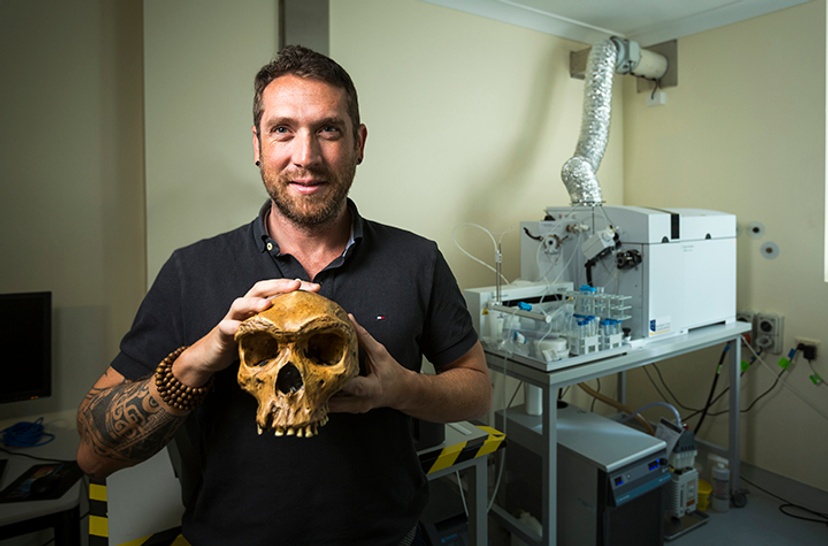
A scientific project led by Southern Cross University is forcing a rethink on our understanding of human evolution.
In 2019, analysis of teeth from Australopithecus africanus fossils found in South Africa and dating back more than two million years revealed that infants were breast-fed continuously from birth to about one year of age.
“For the first time, we have gained new insight into the way our ancestors raised their young and how mothers had to supplement solid food intake with breast milk when resources were scarce,” says Professor Renaud Joannes-Boyau, from the Geoarchaeology and Archaeometry Research Group.
The team – which also included Monash University’s Dr Luca Fiorenza and Dr Justin W Adams – used specialised laser sampling techniques to vapourise microscopic portions on the tooth surface.
As well as providing the first direct proof of maternal roles among Australopithecus africanus, their findings are expanding knowledge on the history of family dynamics, childhood, social organisation and the mother infant bond among one of humankind’s earliest ancestors.
Australopithecus africanus lived from about two-to-three million years ago during a period of major climatic and ecological change. The species was characterised by a combination of human-like and retained ape-like traits For decades there has been speculation about how they raised their young.
The team will now work on species that have evolved since, to develop the first comprehensive record of how infants were raised throughout history.